Our webinars allow users to learn from experts and earn continuing education credits on industry topics, progress in research, services available, and more.
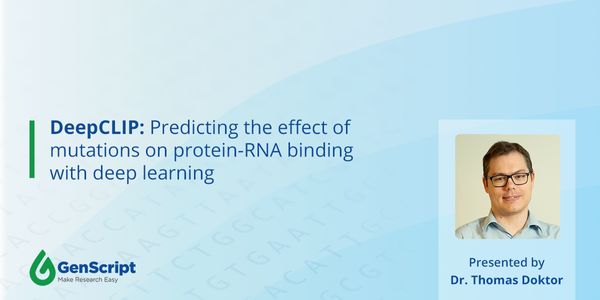
Date: February 24, 2021 Time: 7:00am (PST) Nucleotide variants can cause functional changes by altering protein–RNA binding in various ways that are not easy to predict. This can affec...
This webinar will highlight the importance of top-quality starting materials required for consistent, reproducible drug discovery assays. Topics include blood products, the latest in magneti...
GenScript’s new DNA Encoded Chemical Library (DECL) kit will revolutionize your pharmaceutical hit discovery and chemical biology research. In partnership with a leading technology exp...
Platform based therapeutics and vaccines offer a unique opportunity to simplify and streamline the drug development process. Moderna has taken the approach of harnessing the power of mRNA as...
COVID-19 has changed the way companies operate, the way employees perform their work and the way both are adapting to the environment. In this session, we'll cover both macro industry tr...
The development of different classes of immunotherapies that target cancer cells continues to be a rapidly growing area of research. The development of diagnostic tests which can predict pat...
As pharmaceutical companies have reduced or eliminated neuroscience drug development due to high costs and low approval rates, the economic and healthcare burden of CNS disorders in the Unit...
There are approximately 2000 distinct lipids which are believed to influence health and disease in humans. Their molecular interplay with genes, proteins and metabolites is strongly affected...
The COVID-19 pandemic changed all of our lives in 2020. Development of a COVID-19 vaccine required some re-thinking of the standard vaccine development paradigm. The webinar will cover noncl...
G-protein-coupled receptors (GPCRs) remain major drug targets, despite an incomplete understanding of how they signal through 16 non-visual G-protein signal transducers (collectively named t...
Amyotrophic Lateral Sclerosis (ALS) is a neurodegenerative disease affecting approximately 1 in 50,000 people worldwide. About 10% of these cases are found to have a hereditary component, bu...
Date: February 23, 2021 Time: 8:00am (PST), 11:00am (EST) The analysis of serum free light chains (FLC) is now standard of care in the screening, diagnosis, and monitoring of patients suspec...
Date: February 11, 2021 Time: 10:00am (PST), 1:00pm (EST) Nanobodies are single-domain antibodies derived from heavy-chain-only antibodies (HcAbs) commonly found in camelids, consisting sole...
Date: February 11, 2021 Time: 8:00am (PST), 11:00am (EST) Getting answers on what’s in your precious AAV, LVV, or lipid nanoparticle (LNP) sample means wanting to use the lowest possib...
The concept of the 3Rs remains more prevalent than ever in global discussions related to humane animal use in aspects of research, teaching and testing. The 3Rs serve as a touchstone, in ter...
Date: February 10, 2021 Time: 8:00am (PST), 11:00am (EST) Uncovering the interactions between the immune system and cancer cells or pathogens is key for understanding and controlling both ca...
Maintaining the 3R’s is a critical component of establishing effective training to researchers and others working with animals. Training in a virtual setting easily allows for reductio...
Date: February 10, 2021 Time: 7:00am (PST), 10:00 am (EST) In this talk today we will discuss a new approach to profile influenza proteins. Influenza vaccines typically consist of either a...
Learning Objectives: 1. Define an effective in vitro tissue model 2. Identify the features of a microvasculature 3. Explain the approaches for building in vitro tissue models...
Key to the development of the HUB Organoid Technology was the discovery of LGR5+ intestinal adult stem cells by the Clevers’ lab. With the identification of these stem cells, we were a...
Since the first introduction of the 3R concept in 1959 by Russell and Burch, there has been an increasing interest in finding alternatives to animal testing for ethical and economic reasons....
Organoids are emerging tools to study homeostatic function and disease of human organs. This technology has now for the first time been extended to reptiles by establishing cultures of the s...
Handling laboratory animals can stimulate stress and anxiety that negatively impacts animal welfare and introduces a substantial confounding factor in many areas of scientific research. Howe...
Many of the most debilitating and life-threatening diseases are associated with the central nervous system. Some, such as neurodegenerative diseases, predominately afflict our aging populati...
Primates have been essential in unlocking novel immune mechanisms that have driven development of groundbreaking new drugs in infectious disease and transplantation, amongst others related t...
Pain management includes the choice of analgesia agents, their dose, administration method, duration and frequency of treatment, and a pain-monitoring scheme for each individual animal. Insu...
There is growing concern about the reliability of biomedical research results. Poor experimental design, inappropriate analysis methods and incomplete reporting have all contributed to incon...

 Date: February 24, 2021 Time: 7:00am (PST) Nucleotide variants can cause functional changes by altering protein–RNA binding in various ways that are not easy to predict. This can affec...