What can a rocky molten exoplanet with an atmosphere teach astronomers about planetary formation and evolution? This is what a recent study published in The Astrophysical Journal Letters hopes to address as a team of scientists investigated a thick atmosphere enveloping an exoplanet where previous hypotheses state it shouldn’t exist. This study has the potential to help scientists not only challenge longstanding hypotheses regarding exoplanets but also gain new insight into planetary formation and evolution.
For the study, the researchers used NASA’s James Webb Space Telescope (JWST) to observe TOI-561 b, which is located approximately 86 parsecs (280 light-years) from Earth and whose radius is 1.4 times of Earth. What makes TOI-561 unique is its orbit is only 11 hours long, resulting in an equilibrium temperature of approximately 2500 Kelvin (2,227 degrees Celsius/4,040 degrees Fahrenheit).
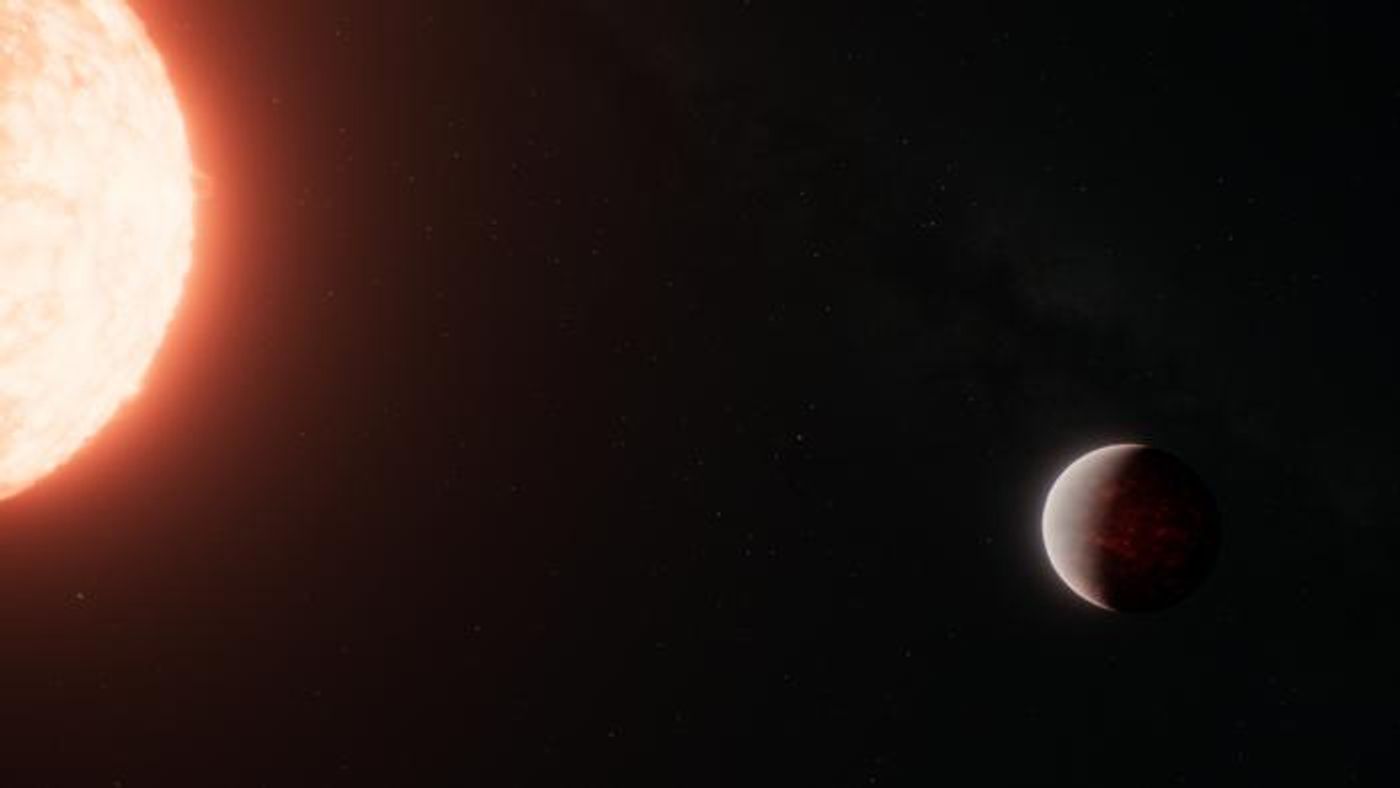
Artist's illustration of TOI-561 b. (Credit: NASA/STSci)
Longstanding hypotheses have noted that exoplanets with these extreme temperatures should not possess atmospheres. However, TOI-561 b’s temperature is lower than models predict, with JWST data indicating it could have a thick atmosphere keeping its temperature lower than expected. These findings challenge planetary formation and evolution models and open the doors for further studies into extremely hot exoplanets with short orbits, known as ultrashort-period (USP) exoplanets.
“What really sets this planet apart is its anomalously low density. It is less dense than you would expect if it had an Earth-like composition,” said Dr. Johanna Teske, who is a staff scientist at the Carnegie Science Earth and Planets Laboratory and lead author of the study. “TOI-561 b is distinct among ultra-short period planets in that it orbits a very old, iron-poor star – twice as old as our sun - in a region of the Milky Way known as the thick disk. It must have formed in a very different chemical environment from planets in our own solar system.”
What new insight into molten and rocky exoplanet atmospheres will researchers make in the coming years and decades? Only time will tell, and this is why we science!
As always, keep doing science & keep looking up!
Sources: The Astrophysical Journal Letters, EurekAlert!