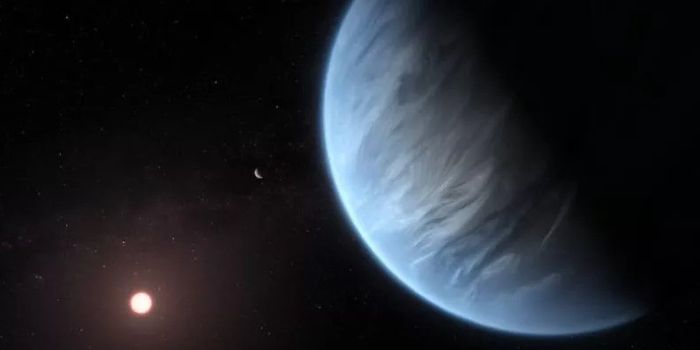
How are the most common types of planets made? This is what a recent study published in Nature hopes to address as a team of scientists investigated the intricate processes responsible for the most common types of exoplanets—super-Earths and sub-Neptunes—to form and evolve. This study has the potential to help scientists better understand not only planetary formation and evolution, but for solar systems, as our solar system doesn’t have super-Earths or sub-Neptunes.
For the study, the researchers conducted a multi-year examination of the V1298 Tau system, which is an approximately 20-million-year-old system located about 350 light-years from Earth and hosts four growing exoplanets orbiting in a tight formation, and each being between 5 to 10 Earth radii. Given the young age of the system, as our solar system is about 4.5 billion-years-old, the goal of the study was to predict the sizes of the four planets when they stop evolving.
In the end, the researchers ascertained that while the four young planets are between 5-10 Earth radii right now, they will end up being between 1-4.5 Earth radii when they are done forming. They note this is due to the rapid cooling they underwent after initial formation due to their small masses and large radii, resulting in their shrinking while losing their atmospheres, with one of the researchers calling this the “missing link” in understanding the formation of super-Earth and sub-Neptunes, which are the most common types of exoplanets.
“What’s so exciting is that we’re seeing a preview of what will become a very normal planetary system,” said Dr. John Livingston, who is an assistant professor at the Astrobiology Center in Tokyo, Japan and lead author of the study. “The four planets we studied will likely contract into ‘super-Earths’ and ‘sub-Neptunes’—the most common types of planets in our galaxy, but we’ve never had such a clear picture of them in their formative years.”
What new insight into super-Earths and sub-Neptunes will researchers make in the coming years and decades? Only time will tell, and this is why we science!
As always, keep doing science & keep looking up!
Sources: Nature, EurekAlert!
Featured Illustration Credit: NASA/FUSE/Lynette Cook